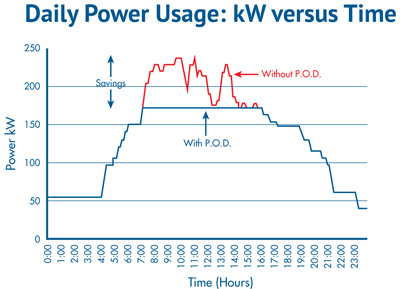
The chart above represents a customer’s peak usage day that was used to determine their “demand charge.” Arista’s Power on Demand system stores the energy captured from their WindTamer turbine and/or solar cells along along with off peak grid power, and then releases the power during peak demand hours. This results in lower demand charges and utility bills for the customer. Use of the Power on Demand system resulted in the following savings:
WindTamer Turbines | Before System | With Power on Demand |
| Monthly Demand Charge | $3,625 | $2,360 |
| Monthly Total (demand & consumption) | $5,967 | $4,607 |
| Annual Utility Costs | $71,607 | $55,284 |
| Annual Savings | $16,323 |
Utility regulators across the United States and in other countries are increasingly allowing – and even encouraging – utilities to impose demand charges on large electricity users as a way to reduce peak demand, which is becoming a growing burden on the electric grid. For many commercial customers, demand charges can comprise 30% to 70% of their electric bills. By some estimates, between 10% and 20% of all electricity costs in the U.S. are attributable to peak demand.